
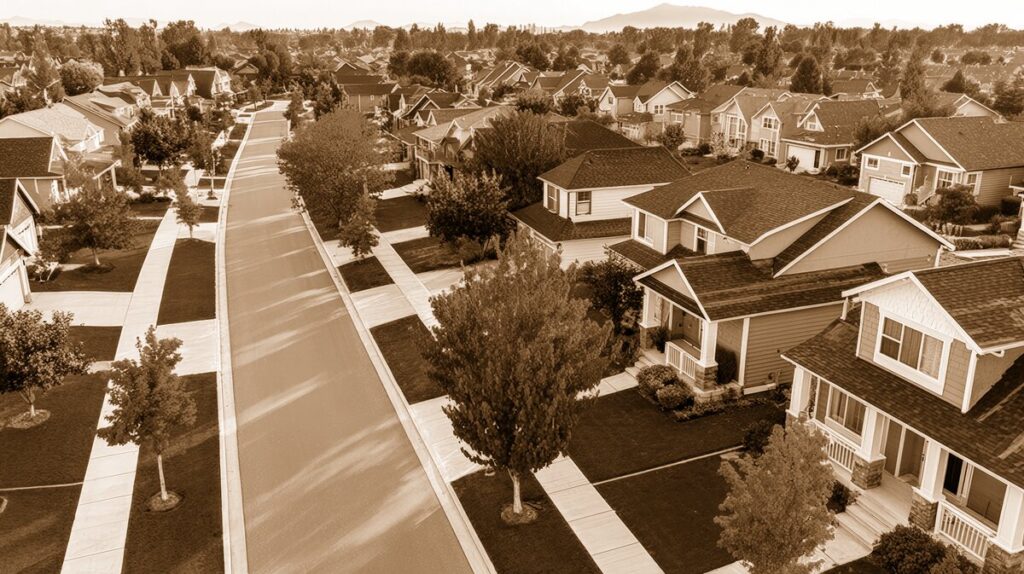
A Neighborhood with a Newer Name and an Older Story
When people talk about Upland Hills, they are usually describing the residential community clustered around Upland Hills Country Club in northwestern Upland, near 16th Street, Campus Avenue, and the Rancho Cucamonga border. The neighborhood’s name is relatively modern, but its story reaches back much farther—to the Native communities, citrus groves, irrigation channels, rail lines, and independent spirit that shaped Upland long before the golf course and surrounding homes appeared.
Upland Hills is not one of Upland’s oldest historic districts in the same way as Old Magnolia or the Euclid Avenue corridor. Instead, it represents a later chapter in the city’s history: the transformation of former agricultural land into a planned suburban neighborhood while preserving the open, green character that has always made north Upland distinctive.
Before Upland Hills: Native Land and Citrus Country
Long before streets such as 16th Street and Campus Avenue were laid out, the region was home to Indigenous peoples, including the Tongva and other Native communities of Southern California. The foothills, streams, and dependable water sources flowing from the San Gabriel Mountains supported travel, gathering, and settlement.
The modern development of Upland began in the 1880s, when George and William Chaffey established the Ontario Model Colony. Their work included a carefully planned irrigation system and the creation of Euclid Avenue, the broad, tree-lined boulevard that remains one of the Inland Valley’s defining landmarks. Water made large-scale agriculture possible, and citrus soon became the economic foundation of the area.
The land that would eventually become Upland Hills was part of this larger agricultural landscape. For decades, north Upland was characterized by lemon and orange groves, ranch roads, windbreaks, packing operations, and broad views toward the mountains. The tidy residential streets of today grew out of that earlier landscape rather than replacing a dense urban neighborhood.
How Upland Got Its Name
The name Upland itself reflects the community’s geography and its relationship with neighboring Ontario. In the late nineteenth century, the area was often called North Ontario or Magnolia. The Magnolia name came from the Magnolia Villa Hotel and the surrounding tract developed during the boom years of the 1880s.
As residents sought a stronger local identity, “Upland” gained favor. The name suggested the community’s slightly higher position above Ontario and its location at the foot of the mountains. In 1906, residents voted to incorporate as the City of Upland.
That history helps explain why “Upland Hills” feels like a natural name. The neighborhood sits in the city’s northern, gently rising section, where the land begins to climb toward the foothills. Its identity combines the city’s long-standing “upland” character with the landscaped, elevated setting of the golf course community.
The City Grows Beyond the Groves
During the first half of the twentieth century, Upland remained closely tied to citrus agriculture. The Santa Fe railroad, packing houses, local businesses, and agricultural associations connected the city to markets throughout the country. Euclid Avenue served as both a transportation route and a civic spine, with its famous central bridle path and canopy of mature trees.
After World War II, the Inland Valley began to change. Citrus acreage declined as land values rose and new housing became increasingly attractive to developers. The opening and expansion of major freeways, including Interstate 10 and later the Foothill Freeway, made it easier for residents to commute to jobs throughout Los Angeles, San Bernardino, and Orange counties.
Upland gradually shifted from an agricultural economy toward a suburban one. Older groves disappeared in many parts of the city, replaced by schools, shopping centers, apartment communities, and single-family neighborhoods. Upland Hills belongs to this postwar and late twentieth-century wave of growth.
The Arrival of Upland Hills Country Club
The most important milestone in the neighborhood’s modern history was the opening of Upland Hills Country Club in 1983. The course gave the surrounding area a strong visual and social identity. Instead of being built as a conventional grid of streets, much of the community was organized around landscaped fairways, open space, and shared recreational amenities.
The Upland Hills Country Club Specific Plan describes a planned community of approximately 215 acres, including residential, recreational, open-space, and related uses. The residential development includes several groupings of condominium and duplex-style homes, many of them constructed during the 1980s and later phases of development.
The course and neighborhood are associated with streets and corridors such as:
- 16th Street, which runs through the heart of the community
- Campus Avenue, an important north-south route along the western side
- 15th Street and 17th Street, which help define the planned area
- 19th Street, a major east-west connection farther south
- Upland Hills Drive and surrounding residential lanes
These streets are familiar to longtime residents not simply as addresses, but as part of the neighborhood’s everyday rhythm—routes to school, the clubhouse, nearby shopping, parks, and neighboring Rancho Cucamonga.
Buildings, Open Space, and Nearby Landmarks
Upland Hills Country Club is the neighborhood’s signature landmark. Its fairways, mature landscaping, clubhouse, banquet facilities, and recreational spaces give the area a distinctly green appearance. Even residents who do not play golf recognize the course as a central part of the community’s visual character.
The neighborhood also benefits from its proximity to several institutions and historic features elsewhere in Upland. A short drive south along Euclid Avenue leads toward the city’s older civic core, including the Carnegie Library, Upland Public Library, and historic downtown. Those buildings connect newer neighborhoods such as Upland Hills to the city’s earlier civic history.
To the north and east, residents are close to the foothill landscape and San Antonio Heights. San Antonio Park and the surrounding mountain views remind visitors that Upland’s identity has always been shaped by its position between the developed valley and the San Gabriel Mountains. Fire Station 2 on San Antonio Avenue, north of 20th Street, is another nearby institution with roots in the city’s twentieth-century growth.
How Upland Hills Has Evolved
Since the 1980s, Upland Hills has matured from a new planned development into an established neighborhood. Young landscaping has become a canopy of shade trees, and the original residents have been joined by second- and third-generation homeowners, renters, retirees, and families drawn to the area’s quieter streets.
The neighborhood has also changed as the wider city has changed. Golf communities are no longer viewed only as exclusive enclaves; the country club has continued to host community events, dining, celebrations, and social gatherings. Nearby shopping and services have expanded, while transportation improvements have made regional commuting more practical.
At the same time, Upland Hills still carries traces of the agricultural landscape that came before it. The broad skies, mountain views, irrigated greenery, and open spaces echo the old citrus country. In that sense, the neighborhood is not disconnected from Upland’s past. It is one of the ways that past was reshaped for a new era.
A Living Chapter of Upland Heritage
Upland Hills may not have Victorian homes or century-old storefronts, but its heritage is visible in the larger patterns of the city: water brought life to dry land, citrus created prosperity, transportation encouraged growth, and changing economic conditions turned groves into neighborhoods.
What makes Upland Hills special is that it captures the transition between old Upland and modern Upland. Its streets are relatively young, yet they rest on land with a much older story. The country club, landscaped residences, nearby parks, and foothill setting create a neighborhood that feels spacious and settled—an inviting place where the city’s agricultural memory remains present in the greenery and open views.
For longtime residents, that blend is the real charm of Upland Hills: it offers the comfort of an established community while preserving a sense of the wide, sunlit landscape that first made Upland worth calling home.